Monday, November 17, 2008

We are where we live? I hope not!

Hey.
I thought that you might find this website interesting:http://www.claritas.com/MyBestSegments/Default.jsp?ID=20&SubID=&pageName=ZIP%2BCode%2BLook-up
I am pretty sure that it is for advertising market research, but I had a lot of fun messing around with it, so I thought you might too.

The deal is, you enter in your zip code and they tell you the segments of the population that live in your area.
An example:When I entered in my current zip code, I got 5 segments of the population. Here is one


Suburban Pioneers represents one of the nation's eclectic
lifestyles, a mix of young singles, recent divorcees,
and single parents who have moved into older,
inner-ring suburbs. They live in aging homes and garden-style
apartment buildings, where the jobs are blue collar
and the money is tight.
But what unites these residents--a diverse mix of whites,
Hispanics, and African-Americans--is a working-class
sensibility and an appreciation for their off-the-beaten-track
neighborhoods.
2007 Statistics:
US Households: 1,171,495 (1.03%)
Median HH Income: $33,448


Lifestyle Traits
  • Eat fast food
  • Do needlepoint
  • Baby Talk magazine
  • King of the Hill in syndication
  • Suzuki Verona
  • Sunday, November 9, 2008

    Skip if you hate cute cat things.

    Philanthropy

    Brent and I went to a book sale at the public library yesterday. We bought 6 new books each. They were all a dollar, which I initially thought was a little pricey, but some of the books I ended up getting had to have cost around 30 dollars new. This was my stash:
    'Handbook of Modern Sociology' -Modern is a relative term as this book was published in 1964.
    Volumes 1 and 2 of the 'Survey of Social Science' -This means I only will know Sociology things starting with the letters A-H.
    'A Sense of Sociology' by Lee Braude- The back says it will tell me what the career-paths of Sociologists are... something I have been dying to find out.
    'Philanthropy: Voluntary Action for the Common Good' by Robert L Payton- This is basically an in-depth look at philanthropy in America.
    'Me: Stories of My Life' by Katharine Hepburn
    Anyways, I am pretty happy with what I picked out. Not a lot of books for light reading, but I'm trying to start my own reference library for when I do research next semester.

    I've been thinking a lot about Philanthropy lately. I looked online for the actual definition:"loving mankind," from phil- "loving" + anthropos "mankind."
    I've been wondering if this is actually possible, to love all of mankind.
    Soren Kierkegaard said that when it comes to love, the particular is higher than the universal. Isn't this true? Is it possible to love everyone as much as you love your family? Are there different levels of love, a top tier for those special few and on down the rungs until you hit mankind? I don't think love works like that. I feel like if you love someone, that you group them in the category with all others that you love.

    Stalin said, "One death is a tragedy, a million deaths is a statistic." You know how much America loves a poster child. On commercials asking us to donate money to starving kids in Africa, they always introduce you to one child and tell you his story. They know people won't donate based on the love of all people in a continent, but people will donate thinking, 'That's so sad, I want to help that boy.' Can we love only an individual? Do we have to know the person, and their specific story in order to love them? I agree you can feel pity or compassion for all mankind, but that's different from love, isn't it?

    Marx loved the workers and hated the owners of the means of production. He was all about dividing people into two specific groups. I've often wondered if his love of the Proles had only to do with their situation. If they had a coup and took over the means of production, would Marx then have loved the new Proles, the guys he hated yesterday? Majorities turn into minorities all the time. Can we actually love a whole group of people just because of their situation in life? Is this really love, or something else? In order to be a true Philanthropist wouldn't you also have to love the new majority, the new oppressors?

    There are lots of jerks who are oppressed. Are we supposed to ignore their jerkiness because of their state? In this way I guess not knowing the individual is actually helpful in loving them. If I knew that the man we were donating money to was a wife beater, it would seriously inhibit my ability to love him. This actually happens to me all the time at football games and amusement parks; I love mankind more before I meet them.

    I guess I'm starting to believe that true Philanthropy is impossible. I think that I believe compassion for large groups of people is possible, but I don't agree that you could love the whole world. I don't even think I could love all of my University, or all of my professors or all of my friends.
    I was a little depressed about this before, because the idea of loving all of mankind is so romantic and selfless.
    Now, I'm beginning to think that love is something too special for the whole world. I think this helps me appreciate those I do know and love because I'm aware that I can only be so big, and know and love a finite number of people.

    Thursday, November 6, 2008

    Equality for All

    I am extremely saddened to learn that Californians voted ‘yes’ on Proposition 8
    to re-ban same-sex marriages, after a judge already ruled that the ban was
    unconstitutional. It is one of first times that Americans have voted to take
    away an existing right from a group of people. President-elect Obama’s historic
    win which overcame decades of discrimination against African Americans was
    bittersweet because other groups are still being actively discriminated against
    in this county. I find the decision to re-ban same-sex marriages in direct
    conflict with Thomas Jefferson’s words in The Declaration of Independence, “We
    hold these truths to be self-evident, that all men are created equal, that they
    are endowed by their Creator with certain unalienable rights, that among these
    are Life, Liberty and the pursuit of Happiness.” Equality is the sentiment our
    country was founded on, and one we should strive to uphold.

    Thursday, October 30, 2008

    A True, First Person Account

    I thought that I would tell you about a little book that I picked up at the Goodwill the other day. Brent and I went to find Halloween costumes, and ended up spending the whole time with our heads tilted sideways in the book section reading the titles.
    One of the 10 books that I ended up buying was called:
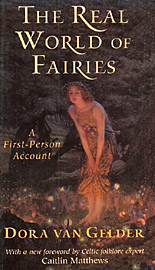
    The Real World of Fairies: A true, first person account
    by Dora van Gelder

    I googled the title and came up with this image from a revised version. You will note that the word 'true' was taken out of the title, but my version, published in 1988, still said true.
    My copy is also acid green with a pink and orange fairy on the cover, mid-hop.
    This book is exactly what it sounds like, only maybe a little bit stranger. According to the back of the book, the author Dora van Gelder, "...grew up pretty much alone on her father's plantation in Java, where her only playmates were the flower and shrub fairies."

    In case you hadn't gathered this already, the lady is insane. In her book, van Gelder describes interactions she has had with fairies, as well as with angels (angels, you guys, angels) who are in charge of the fairies. She also describes all the types of fairies in the world, here is a short list and description:
    Earth fairies: split up into surface creatures (tree spirits, mountain fairies, the common garden fairy) and under the surface creatures (rock spirits which are like tree spirits but much less intelligent, and gnomes).

    Water fairies: 3 main kinds- Water Babies who live on the surface of the ocean and in bays and look like fat, human babies, Fairies of the Middle Deeps who live on the high seas, are 5-7 feet tall, blue-black in color and look like Russian wolf-hounds (no lie, you guys, it says that), and a third kind, un-named, who lives in the 'great depths of the ocean' and look like great gorillas covered in dark blue fur. Gelding says they are hostile to humans, so watch out for these!
    RUSSIAN WOLF-HOUND

    Fire fairies: 2 kinds- small ones who are 2 feet high and that look like just a foggy outline, and big ones who are 14 feet tall, live in volcanoes and who Ms. van Gelder calls "salamanders".

    There are many more types of fairies and descriptions of fairies but I just wanted you to understand the nature of this book. It was published by 'The Theosophical Publishing House'.

    According to Wikipedia, Theosophy is a doctrine of religious philosophy and metaphysics. This is their symbol:

    I went to the publisher's website (http://www.questbooks.net/) and found a list of some of their other top sellers:
    Grammar for the Soul: How a Mere Comma Can Make Your Day,
    Yoga of Time Travel; How the Mind Can Defeat Time,
    The Healing Powers of Tone and Chant, and
    Sacred Space, Sacred Sound; The Acoustic Mysteries of Holy Places.

    Wednesday, October 29, 2008

    A Few Things

    Hey guys.


    I just wanted to tell you about a few interesting things I've learned lately. I'm wondering which areas of Sociology you're most interested in hearing about, so that I don't bore you talking about only Urban Soc or something when you really want to be hearing neat things about Social Movements or Criminology.
    Let me know which of these you find interesting. In this first p
    art, here’s a little Urban Soc and Criminal Justice. Social Stratification, Criminology, Social Movements, and Sociology of Religion to come.

    Social Conflict and Criminal Justice class:

    This came up while discussing conformity: "Because people pay attention to the views of those they know, different groups can converge on dramatically and sometimes amusingly different actions and beliefs. 'Many Germans believe that drinking water after eating cherries is deadly; they also believe that putting ice in soft drinks is unhealthy.'" I found this interesting because Luke said in his blog (http://entzaubert.blogspot.com/) that he found it weird that no where in Berlin could he get an ice cube. Perhaps this is why!

    ALSO: If a Republican judge is sitting on the bench with two other Republican judges, she is VERY likely to vote along conservative lines. The same goes for a Democrat with other Democrats. Sunstein calls this 'ideological amplification'.
    However, a single Democrat sitting with two Republicans is more likely to vote like a Republican, and vice versa. This is called 'ideological dampening'.


    Now, Pay attention, because this is where it gets weird!
    We actually did the experiment that is outlined in Sunstein's book in m
    y Social Justice class today.

    A student was given a mock-court case
    and asked to decide the defendant's punishment on a scale of 1-10, 10 being the most severe. According to response, the student was put into a group with other students. "When a majority of individuals...initially favored little punishment, the student-jury's verdict showed a 'leniency shift,' meaning a verdict that was systematically lower than the median rating of the individual members before they started to talk." (Sunstein, pp5)
    Sunstein goes on to say that when the majority of individuals initially favored strong punishment, the group produced a 'severity shift'.

    "When members of a group are outraged, they end up still more outraged as a result of talking to one another."
    The mock-jurors ended up giving a harsher punishment than any of them thought was fit using their individual value system.

    Do any of you guys have an idea about what causes this? I have a few, but I'm interested to hear what you think!


    Urban Sociology class:
    An economic ghetto (also know as a 'slum') has a lot to offer people, according to my teacher. He says some of the opportunities that slum's offer are:
    Anonymity: they're good to get lost in if you're a criminal
    Economy: some people who aren't very poor live in ghettos to save money
    Easy access to vices: drug addicts, alcoholics and gamblers can live cheaply and enjoy themselves
    Humanitarian opportunities: you can run a soup kitchen, minister to the poor etc.
    So basically, not just poor people live in slums. People who could live elsewhere choose to live in them because of their great opportunities.


    He also said that researches have done studies and found the same level of resident satisfaction in these ghettos as with people who live in suburbs. These communities are very functional, and the people that reside in them all know each other. They just gather around the soup kitchen, instead of working class neighbors who gather round the bar, and middle class neighbors who gather in that special room they that no one but company is allowed in with the plastic on the furniture, and the upper class who gather round the country club.

    Tuesday, October 28, 2008

    The Capitalist Bourgeoisie Trying to Block Proles from the Rocks and Stocks

    In Statistics class today (the one part of social research I HATE) my teacher showed a video.


    I thought it was pretty funny, but most of the kids in my class were way too cool to laugh. I love it when people take sort of nerdy, academic things and make them fun.

    I was inspired to write my own lyrics to 'Give it to Me' by Timbaland. In case you aren't familiar with the song, Nelly Furtado, Justin Timberlake and Timbaland all sing a verse. In my new and improved Sociology version, the verses are sung by the father's of modern sociology, Karl Marx, Emile Durkheim and Max Weber respectively. For example, where Nelly had sung, "I'm a supermodel and mami, si mami," Marx now sings, "I've shaped Socialists and Commies, yeah Commies." How awesome does that sound? So, as soon as I can find a just instrumental version of that song, I will record it and post it on here.